NYC Property Tax

NYC 2025-26 3Q Property Tax Bills Are Now Online
Published 11/19/2025 at 11:50 AM
By: Benjamin M. Williams
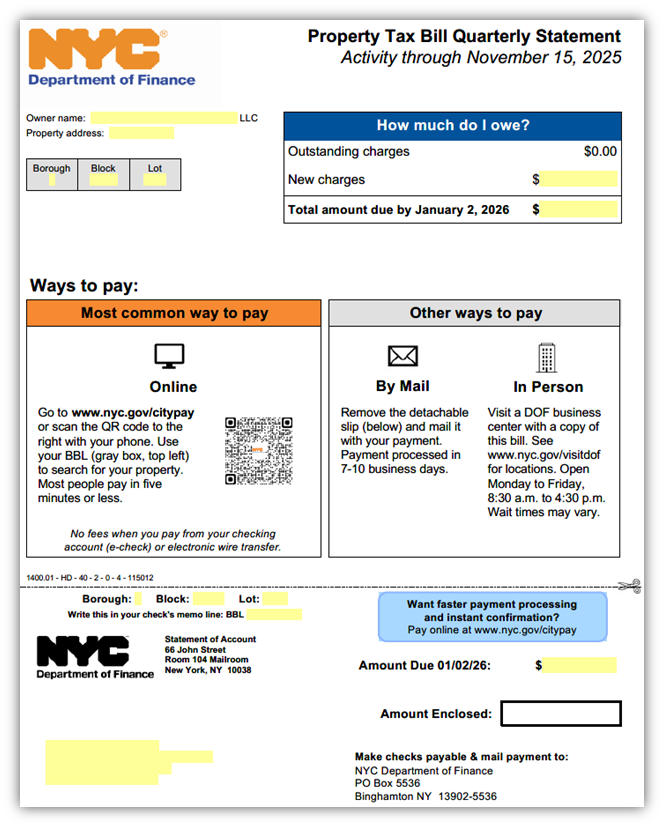
On November 19, 2025, the New York City Department of Finance (DOF) posted the third-quarter / second-half property tax bills for the 2025/26 tax year (July 1, 2025 – June 30, 2026).
These bills are dated November 15, 2025 and cover charges due January 2, 2026. They appear online as:
“2025-2026 Q3 November 15, 2025” Property Tax Bill Quarterly Statement
As I explained in my earlier post on the final 2025/26 property tax rates, the City has now adopted the new tax rates for all tax classes, and DOF has updated your bill accordingly. Tax class 4 rates increased; tax classes 1 and 2 decreased.
(That prior post is available here: NYC Final Property Tax Rates for 2025/26)
What this new bill reflects
The Q3 / second-half bill does a few important things:
- Applies the final 2025/26 tax rates adopted this fall.
- Updates your “Amount Due by January 2, 2026” to reflect those rates.
- Shows, on page 2, how DOF is calculating your annual property tax for this year, including:
- Estimated market value
- Tax class (e.g., tax class 1, tax class 2, tax class 4)
- Prior-year tax rate vs. current tax rate
- Billable assessed value
- The multiplication of the billable assessed value by the current tax rate to arrive at your annual property tax, less exemptions and abatements.
Because these bills now reflect the final rates, your January 2, 2026 payment amount will be different from what DOF billed you on the 1Q and 2Q statements which were based on last year’s rates.
How to view your 2025/26 Q3 property tax bill
You can view and download your bill online through DOF’s Property Tax system:
- Go to:
https://a836-pts-access.nyc.gov/care/forms/htmlframe.aspx?mode=content/home.htm - On the left-hand side, click “Property Tax Bills.”
- In the list of available statements, select:
“2025-2026 Q3 November 15, 2025.”
From there you can view the Property Tax Bill Quarterly Statement, save it as a PDF, or print a copy for your records.
What to review on your new bill
When you open the Q3 bill, I recommend focusing on a few key items:
- Amount Due by January 2, 2026
Confirm that your payment schedule (including any mortgage escrow) lines up with this updated figure. - Tax class and billable assessed value
Make sure the tax class (e.g., tax class 1, tax class 2, tax class 4) and billable assessed value match your expectations based on earlier Notices of Property Value and prior bills. - Current vs. prior-year tax rate
Page 2 shows both the prior-year and current tax rates for your tax class. This is where you can see how much of the change in your bill is driven by the new rate versus changes in assessed value. - Exemptions and abatements
Verify that any exemptions or abatements that should apply to your property (for example, co-op/condo abatements, ICAP or other program benefits) are still listed and correctly reflected in the total. - Other Charges and activity
Verify that other charges, like Rent stabilization and Sign charges, are correct. DOF posted on 11/06/2025 the RPIE-2024 Non-Filing Penalties, so these 3Q statements are the first property tax bills reflecting those new penalties (see my prior blog post: How to Avoid RPIE-2024 Non-Filing Penalties). - Standard reminders and compliance notices
Page 3 will often include reminders about RPIE filing, energy benchmarking, and Local Law 97 greenhouse gas requirements. These are generic messages, but they are good prompts to check that you are on track with any required filings or compliance planning.
Why this matters for budgeting and planning
Because the final tax rates are now in effect for 2025/26, this bill is a reliable basis for:
- Updating your building’s operating budget for the second half of the fiscal year, and first half of calendar year 2026.
- Adjusting maintenance charges or common charges for co-ops and condos, if needed.
- Evaluating whether your assessed value and tax class still make sense in light of market conditions and recent comparable properties.
For many owners and boards, this is also a good moment to start thinking about next year’s tax protest strategy, since the same factors that drive your current tax bill—assessed value, tax class, and comparables—will affect future assessments.
Questions about your 2025/26 bill?
If you have questions about how DOF calculated your 2025/26 third-quarter / second-half bill, or if your assessed value, tax class, exemptions, or abatements do not look right, consider speaking with your property tax advisor about next steps.
In the meantime, be sure to:
- Download your 2025-2026 Q3 November 15, 2025 bill, and
- Calendar the January 2, 2026 due date to avoid interest and penalties.
I will continue to post updates as DOF releases additional information or if there are any further changes affecting the 2025/26 property tax year.