NYC Property Tax

Governor Signs J-51 Renewal Bill into Law for NYC Residential Buildings
Published 5/28/2026 at 9:41 AM
By: Benjamin M. Williams
On May 28, 2026, the New York State Governor signed the budget bill renewing and revising the J-51 rehabilitation tax abatement program for New York City residential buildings.
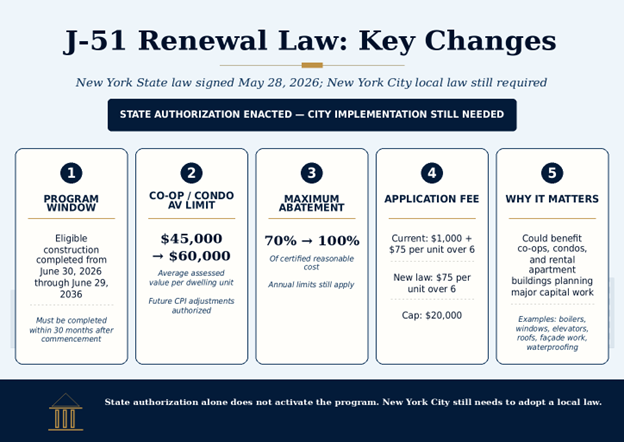
Although the State bill is now law, it does not by itself make new J-51 benefits available. The new State law authorizes New York City to adopt a local law implementing the renewed abatement program for eligible construction completed on or after June 30, 2026 and before June 30, 2036. The current J-51 Reform Program applies to eligible construction completed after June 29, 2022 and on or before June 29, 2026.
The State renewal is important for co-ops, condos, and rental apartment buildings planning major capital work, including projects involving boilers, windows, elevators, roofs, façade masonry, waterproofing, plumbing, electrical work, and other eligible building improvements.
City Council action is still required
The State law does not automatically make new J-51 benefits available. It authorizes New York City to adopt a local law implementing the abatement. The Governor signed the bill into law on May 28, 2026, after both houses passed the bill on May 20, 2026. The City Council still needs to act before buildings can receive benefits under the renewed program.
Mayor Mamdani, the City Council, and HPD have shown their support for J-51, so we expect (but do not guarantee) a local law will eventually pass too. Mamdani mentioned J-51 as recently as May 26, 2026, in his Block by Block housing plan (page 30). City Council Speaker Julie Menin supported J-51 in her February 11, 2026 Senate testimony. HPD Commissioner Dina Levy mentioned support of J-51 in her May 4, 2026 City & State interview.
Buildings planning work near the June 2026 transition should pay close attention to commencement dates, completion dates, the City Council’s next steps, and future HPD guidance.
Longer window: projects completed through 2036
The renewed State law authorizes a program that would apply to eligible construction completed on or after June 30, 2026 and before June 30, 2036, provided the work is completed within 30 months after commencement and New York City adopts the required local law.
If implemented by local law, that longer window would make J-51 more useful for capital planning. Instead of treating J-51 as an after-the-fact benefit, boards and owners may be able to consider J-51 while planning multi-year capital projects.
Co-op and condo AV threshold would increase to $60,000 per unit
One of the biggest changes in the new State law is for co-ops and condos.
Under the current J-51 Reform Program, an eligible homeownership building must have an average assessed valuation no greater than $45,000 per dwelling unit as of commencement.
Under the renewed program authorized by the new State law, that limit would increase to $60,000 per dwelling unit, with future CPI adjustments. The law would also require HPD to publish the adjusted limit annually after the City local law becomes effective.
This could make J-51 available to more co-op and condo buildings, especially buildings that were previously just above the $45,000 per-unit limit.
The timing matters because the AV test is measured as of the date the eligible construction commences. A building that is under the limit today may not be under the limit in a later year if assessed values increase. Co-ops and condos planning substantial work should evaluate eligibility before assuming they will qualify later.
Maximum abatement would increase from 70% to 100% of certified reasonable cost
The current J-51 Reform Program provides benefits up to 70% of approved certified reasonable cost.
Under the renewed program authorized by the new State law, the maximum benefit would increase to 100% of total certified reasonable cost, subject to annual limits. For co-ops, condos, and certain regulated homeownership or limited-profit housing buildings, the annual benefit would still be limited to 50% of real property taxes payable for the relevant twelve-month period.
For example, if a building has $1,000,000 of approved certified reasonable cost, the current 70% cap would limit the total abatement to $700,000. A 100% cap could increase the maximum total abatement to $1,000,000, subject to the annual limits, other program rules, and City local law.
Application fees would be reduced and capped
The current J-51-R application fee is $1,000 plus $75 for each dwelling unit in excess of six.
Under the renewed program authorized by the new State law, the application fee would be $75 for each dwelling unit in excess of six, with a $20,000 cap per application, adjusted annually by CPI.
This would reduce the filing cost for many applicants, especially larger buildings.
Tenant notices and pre-commencement planning remain important
The new State law includes tenant-notice requirements for eligible construction that commences on or after the effective date of the City local law. The notice must be provided not more than 180 days and not less than 30 days before commencement and must include information about the proposed work, the building representative, and tenants’ rights.
This is an important planning issue. Ordinary construction notices may not satisfy J-51 requirements. Buildings should address J-51 notice requirements before work begins.
What buildings should do now
Co-ops, condos, and rental apartment buildings planning major capital work should review:
- whether the planned work is likely to be eligible;
- whether the building satisfies the applicable J-51 category;
- the average assessed value per unit for co-ops and condos;
- the expected commencement and completion dates;
- whether tenant notices or HPD notices will be required before commencement; and
- whether the current J-51-R program or the renewed program, assuming City implementation, is the better fit.
The State renewal is now law, but it is not yet a substitute for building-specific analysis. Eligibility will depend on the State law as enacted, the City Council’s local law, HPD rules, the building’s assessed value, the project scope, and the project timeline.
This article covers the major changes in the State law that may be of interest to our readers. It is not intended to be a complete review of all provisions of the new law.
See our prior recent blog posts about J-51:
- Updated Senate Bills Would Make Several Notable Improvements to J-51
- Housing Stakeholders Support J-51 at the Joint Legislative Budget Hearing
- Hochul’s FY 2027 Budget Would Extend and Reform J-51 Again: What NYC Buildings Should Know (and Watch)
- J-51 Updates for January 2026
- Happy 2nd Birthday to the State’s J-51 Enabling Law – and a Call to Extend the Program
This blog is a form of attorney advertising. We provide this information as a service to our clients and other readers for educational purposes only. Nothing in this blog should be construed as, or relied upon, as legal advice or as creating a lawyer-client relationship.